Contents
1. Test Structure, Directions & Domain Map
2. Arithmetic Foundations, Exponents & Radicals
3. Percentages, Ratios, Rates, Proportions & Units
4. Statistics, Data, Inference & Probability
5. Linear Equations, Systems & Inequalities
6. Functions & Linear Equations
7. Quadratics, Parabolas & Nonlinear Equations
8. Exponential Models, Polynomials & Function Structure
9. Lines, Angles, Triangles & Coordinate Geometry
11. Trigonometry & the Unit Circle
12. Area, Surface Area, Volume & Scale
13. Strategy, Desmos & the Last 50 Points
How to use this handbook
Use this as a compact reference, not as a list to memorize blindly. The goal is to recognize structure quickly, know which formulas matter, and make better decisions under time pressure.
- PROVIDED ON SAT means the relationship appears on the official Math reference sheet.
- KNOW means the relationship is worth recognizing quickly and using confidently.
- SAT HABIT highlights a decision that prevents unnecessary work or a common mistake.
- DESMOS DECISION highlights situations where the calculator is useful, or where it may slow you down.
Test Structure, Directions & Domain Map
Standard Math section structure
| Module | Questions | Time |
|---|---|---|
| Module I | 22 | 35 minutes |
| Module II | 22 | 35 minutes |
| Total | 44 | 70 minutes |
Each module contains 20 operational questions and 2 pretest questions. Pretest questions are not identified to students and do not count toward the score.
The first module contains a mix of difficulty levels. Performance in Module 1 determines the targeted difficulty route for Module 2. Within each module, questions generally progress from easier to harder.
Approximately 30% of Math questions are set in a real-world, science, or social-science context.
Content domains
| Domain | What it includes | Approx. share |
|---|---|---|
| Algebra | Linear equations in one and two variables, linear functions, systems, linear inequalities in one or two variables | About 35% |
| Advanced Math | Equivalent expressions; absolute value, quadratic, exponential, polynomial, rational, radical, and other nonlinear equations and functions | About 35% |
| Problem-Solving and Data Analysis | Ratios, rates, proportional relationships, units, percentages, one- and two-variable data, probability, inference, margin of error, studies and experiments | About 15% |
| Geometry and Trigonometry | Area and volume, lines and angles, triangles, right-triangle and unit-circle trigonometry, circles | About 15% |
Question types
| Type | Approx. share | What to do |
|---|---|---|
| Multiple Choice | About 75% | Choose one correct answer from A, B, C, and D. |
| Student-Produced Response | About 25% | Enter your own answer using the Bluebook response box. |
Student-Produced Response rules
- Positive answers can use up to 5 characters.
- Negative answers can use up to 6 characters, including the negative sign.
- If a fraction does not fit, enter an equivalent decimal.
- If a decimal does not fit, round or truncate at the fourth digit as instructed by the test directions.
- Enter mixed numbers as improper fractions or decimals.
- Do not type symbols such as
%,$, or commas. - If more than one answer is correct, enter only one valid answer.
SAT Math defaults worth knowing
Unless the question states otherwise:
- Variables and expressions represent real numbers.
- Figures are drawn to scale.
- Figures lie in a plane.
- The domain of a function is the set of real input values for which the function gives a real output.
CALCULATOR POLICY
Calculator use is permitted throughout SAT Math. Bluebook includes Desmos scientific and graphing calculators. Approved non-CAS handheld calculators may also be used. CAS calculators are not permitted under the current policy. A calculator is available, but it is not always the fastest first move.
Arithmetic Foundations, Exponents & Radicals
Arithmetic fluency still matters
- Be comfortable with fractions, decimals, percentages, ratios, negative numbers, exponents, radicals, and order of operations.
- A calculator is available on every Math question, but using it for every step can make simple work slower.
- Watch units. A correct calculation with the wrong unit is still a wrong answer.
- Estimate before calculating when possible. A rough estimate can eliminate unreasonable answer choices.
Exponents
Same base: add exponents when multiplying.
Same base: subtract exponents when dividing.
Multiply exponents when raising a power to a power where the rule is valid: for example, a positive real base, or integer exponents with defined expressions. Do not apply it blindly to negative bases with fractional exponents.
A negative exponent means reciprocal; the base must be nonzero.
Fractional exponents connect powers and radicals. Reduce the rational exponent first and check the real-number domain; even roots require a nonnegative radicand.
SIGN TRAP: For integer powers, an even power of a nonzero real number is positive; an odd power preserves the sign of its base. Zero to a positive integer power is zero. Remember: −x² = −(x²), whereas (−x)² = x².
Radicals
Use this real-number rule only when the expressions are defined.
The principal square root is nonnegative.
For an even root such as , the radicand must be nonnegative in a real-number problem.
After squaring both sides of an equation, check every candidate in the original equation. Squaring can create extraneous solutions.
SAT HABIT
Simplify before reaching for Desmos. Exponent structure is often faster to recognize by hand than to type.
Percentages, Ratios, Rates, Proportions & Units
Percent change
For the magnitude of a percent decrease:
Example: increase by 15% means multiply by . Decrease by 15% means multiply by .
IMPORTANT
A 20% increase followed by a 20% decrease does not return to the original value because .
Percentage points are not percent change
If a rate increases from 40% to 50%, the increase is 10 percentage points, but the relative percent increase is
Ratios and proportions
Cross multiplication is useful, but first check whether simple scaling is faster.
Rates and proportional relationships
A rate compares quantities with different units.
Common structure:
For a direct proportional relationship:
where is the constant of proportionality.
SAT HABIT
If the problem gives a rate such as dollars per item, miles per hour, or grams per liter, write the units directly into the calculation. Units often reveal the correct operation.
Scale factor for similar figures
Units
- Convert before combining quantities if the units are different.
- For compound units, treat units like algebra: .
- Area conversions are squared. Volume conversions are cubed.
SAT HABIT
If the answer choices use a different unit from the question, convert before selecting an answer.
Statistics, Data, Inference & Probability
One-variable data
- Median: middle value after arranging the data. If the number of values is even, average the two middle values.
- Mode: most frequent value.
- Range: maximum minus minimum.
- Standard deviation: measures spread. More spread generally means a larger SD; tighter clustering means a smaller SD.
- Outliers usually affect the mean more strongly than the median.
Weighted mean
When groups have different frequencies or weights:
How transformations affect a data set
| Transformation | Effect |
|---|---|
| Add the same constant to every value | Mean and median each increase by ; SD stays the same. |
| Multiply every value by | Mean and median multiply by ; SD multiplies by . |
Reading distributions
For dot plots, histograms, box plots, and frequency tables, compare:
- center: mean or median,
- spread: range or standard deviation,
- shape: clustering, symmetry, skew, gaps,
- unusual values: possible outliers.
Two-variable data
- A scatterplot shows the relationship between two quantitative variables.
- A line of best fit summarizes an approximately linear trend.
- The slope of a fitted line represents the predicted change in for a one-unit increase in .
- The intercept should be interpreted only when is meaningful in context.
A positive residual means the observed value lies above the model prediction. A negative residual means it lies below.
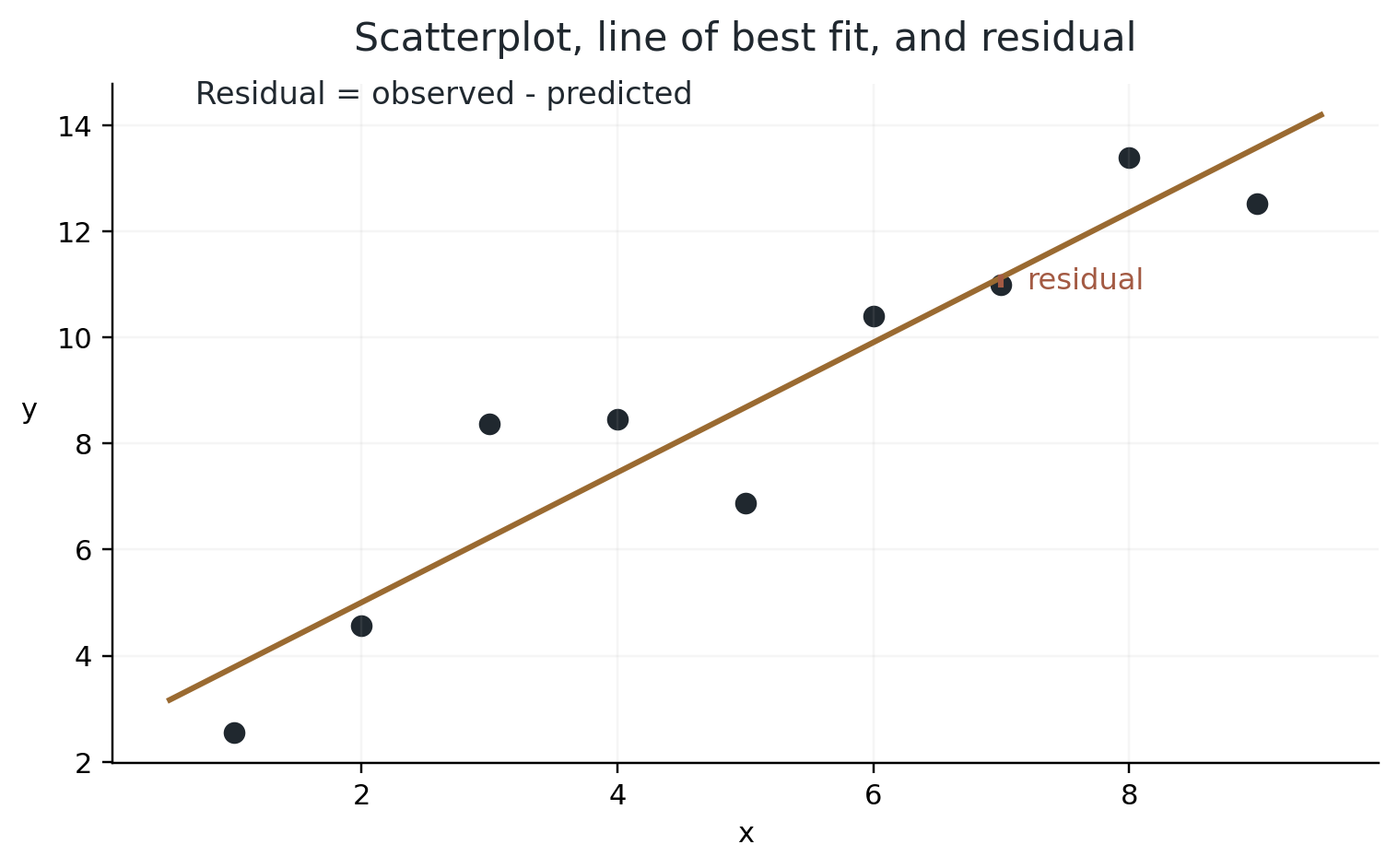
Concept diagram: scatterplot, line of best fit, and one residual.
Linear vs exponential models
- Linear: equal input increases produce approximately equal additive changes in output.
- Exponential: equal input increases produce approximately equal multiplicative or percent changes in output.
If a quantity grows by a constant amount, think linear. If it grows by a constant percentage, think exponential.
Two-way tables and relative frequency
A two-way table organizes two categorical variables. Always identify whether a question asks for:
- a joint frequency,
- a row or column total,
- a relative frequency,
- a conditional proportion.
For a conditional proportion, the denominator is the total of the condition group.
Sampling, inference, and experiments
- A random sample supports generalizing results to the population from which the sample was drawn.
- A large biased sample is not automatically better than a smaller representative random sample.
- A larger random sample generally produces a smaller margin of error, all else equal.
- Random assignment in an experiment supports cause-and-effect conclusions.
- Random sampling and random assignment solve different problems: one supports generalization, the other supports causation.
- Correlation describes association, not causation.
A confidence interval should be interpreted in the context of the population parameter being estimated.
Probability
When outcomes are equally likely:
Complement rule:
Conditional probability:
For independent events:
For mutually exclusive events:
SAT HABIT
Read the denominator carefully. Conditional probability changes the population you are considering.
Linear Equations, Systems & Inequalities
One-variable equations
- Simplify both sides before deciding the number of solutions.
- If the variable terms cancel and a false statement remains, such as , there is no solution.
- If everything cancels and a true statement remains, such as , there are infinitely many solutions.
- Otherwise, there is exactly one solution.
Systems of two linear equations
| Number of solutions | Geometric meaning |
|---|---|
| Exactly one | Different slopes, one intersection |
| No solution | Same slope, different intercepts, distinct parallel lines |
| Infinitely many | Same line |
For
and
coefficient ratios give a quick test:
Use these ratios only when their denominators are nonzero. More generally, ae − bd ≠ 0 gives exactly one solution. If ae − bd = 0, compare the complete equations: proportional equations describe the same line; inconsistent constants give no solution. Each equation must actually define a line.
Linear inequalities in one variable
You may add or subtract the same quantity on both sides without changing the inequality direction.
When you multiply or divide both sides by any negative number, reverse the inequality sign.
Linear inequalities in two variables
A two-variable inequality represents a region, not just a line.
- Use a solid boundary for or because points on the boundary are included.
- Use a dashed boundary for or because points on the boundary are not included.
- Test a convenient point, often if it is not on the boundary, to determine which side to shade.
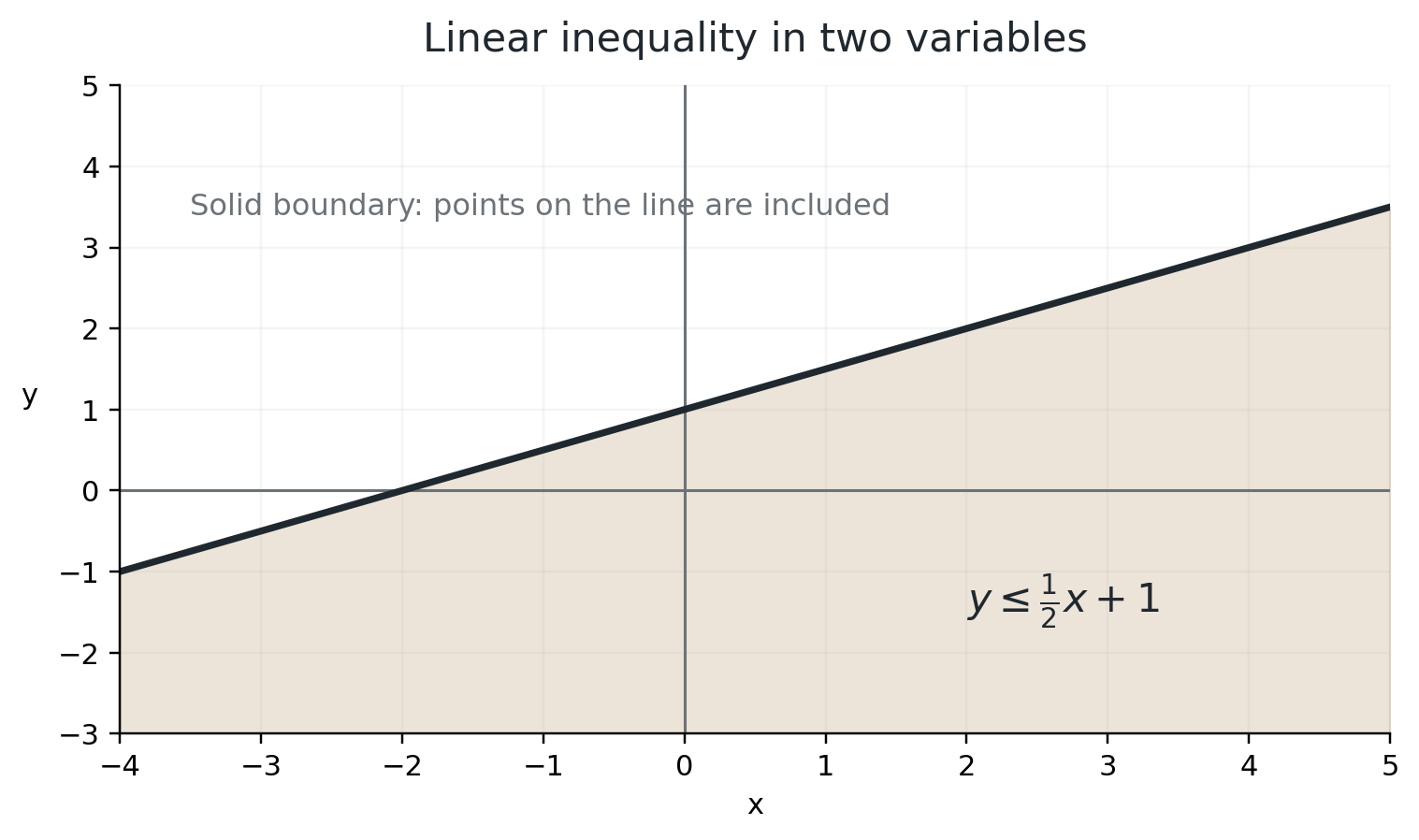
Concept diagram: the solution set of a linear inequality is a region.
DESMOS CAN HELP
Graphing two equations can reveal whether lines intersect once, never, or lie on top of each other. For parameter questions, coefficient structure is often faster.
Functions & Linear Equations
Equation of a line
A linear equation describes a straight line in the -plane. A point lies on the line if its coordinates satisfy the equation.
Slope-intercept form
where:
- is the slope,
- is the -intercept.
The -intercept is the value of when .
Standard form
For a nonvertical line written in standard form:
and
You do not need to memorize these two results if you can isolate :
Slope
Slope measures the change in for a given change in .
If a line makes an angle with the positive -axis:
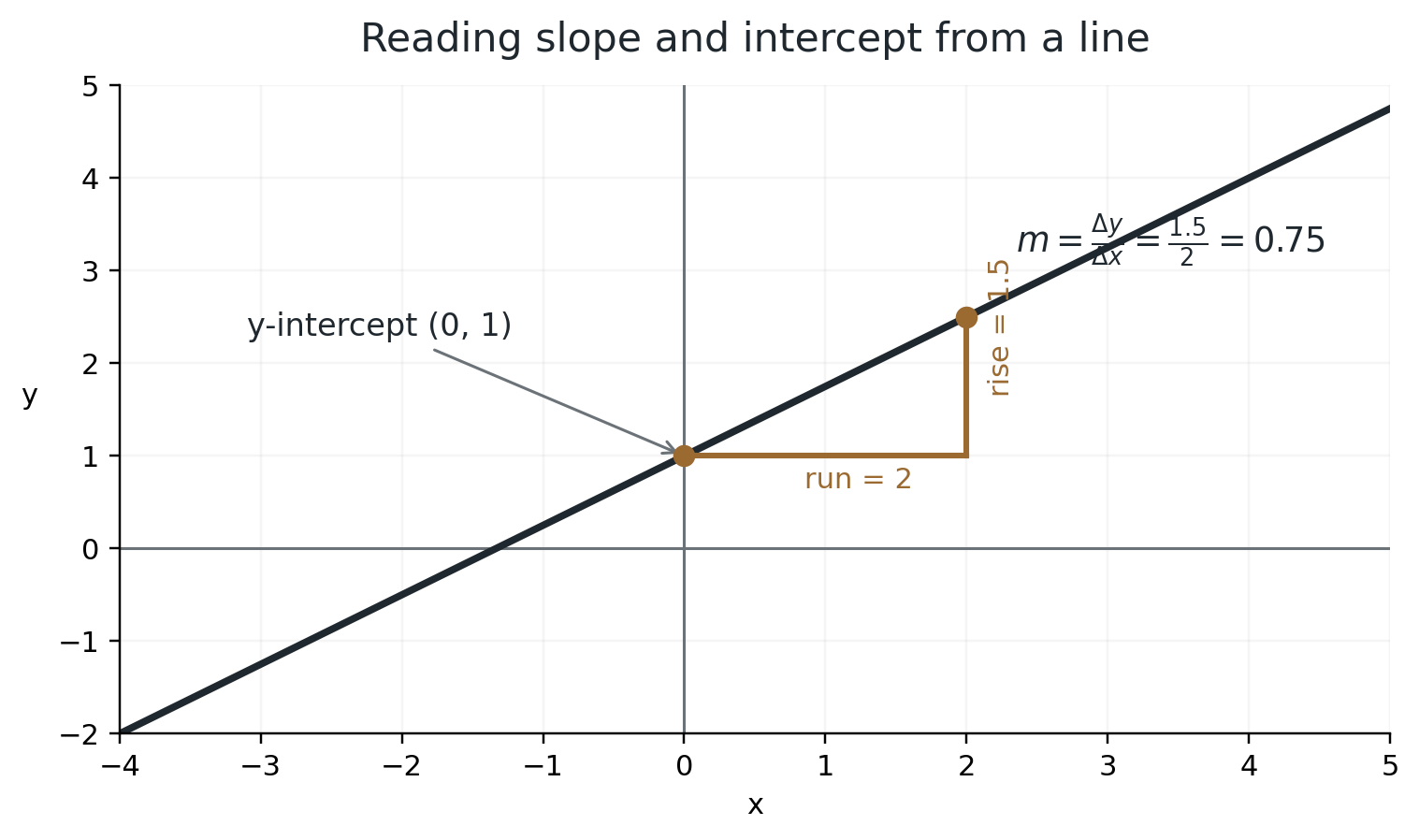
Concept diagram: slope and y-intercept.
Writing the equation of a line
1. Slope and y-intercept are given
2. Slope and one point are given
3. Two points are given
First find the slope:
Then use point-slope form:
Interpreting slope and intercept in context
For a model :
- represents the change in the output for each one-unit increase in the input.
- represents the predicted output when the input is zero.
- Always include units when interpreting either value.
- Do not force an intercept interpretation if input zero is not meaningful in the situation.
Relationship between two lines
- Same line: same slope and same intercept.
- Parallel: same slope, different intercepts.
- Perpendicular: slopes are negative reciprocals, when both slopes are defined.
Example: if , a perpendicular slope is .
Roots, zeros, solutions, and x-intercepts
The terms root, zero, solution, and -intercept refer to an -value for which
For a linear function , set :
Function notation and features
- means substitute for the input wherever appears in .
- A point lies on when .
- The -intercept is when is in the domain.
- The domain is the set of allowed inputs.
- The range is the set of possible outputs.
- Intercepts, maxima, minima, increasing/decreasing intervals, and end behavior are all ways to describe function behavior.
SAT REMINDER
Before doing several lines of algebra, check what the question actually asks for. If it asks for a slope, intercept, or particular expression, you may be able to obtain it directly without finding the entire equation.
Quadratics, Parabolas & Nonlinear Equations
Quadratic equations
Quadratic formula:
Sum and product of roots:
Discriminant
- : no real roots.
- : one distinct real root.
- : two distinct real roots.
Three useful forms of a parabola
| Form | Equation | What it shows quickly |
|---|---|---|
| Standard | -intercept | |
| Factored | real roots | |
| Vertex | vertex |
If , the parabola opens upward and the vertex is a minimum. If , it opens downward and the vertex is a maximum.
Axis of symmetry:
If two real roots are known, their average is the axis of symmetry:
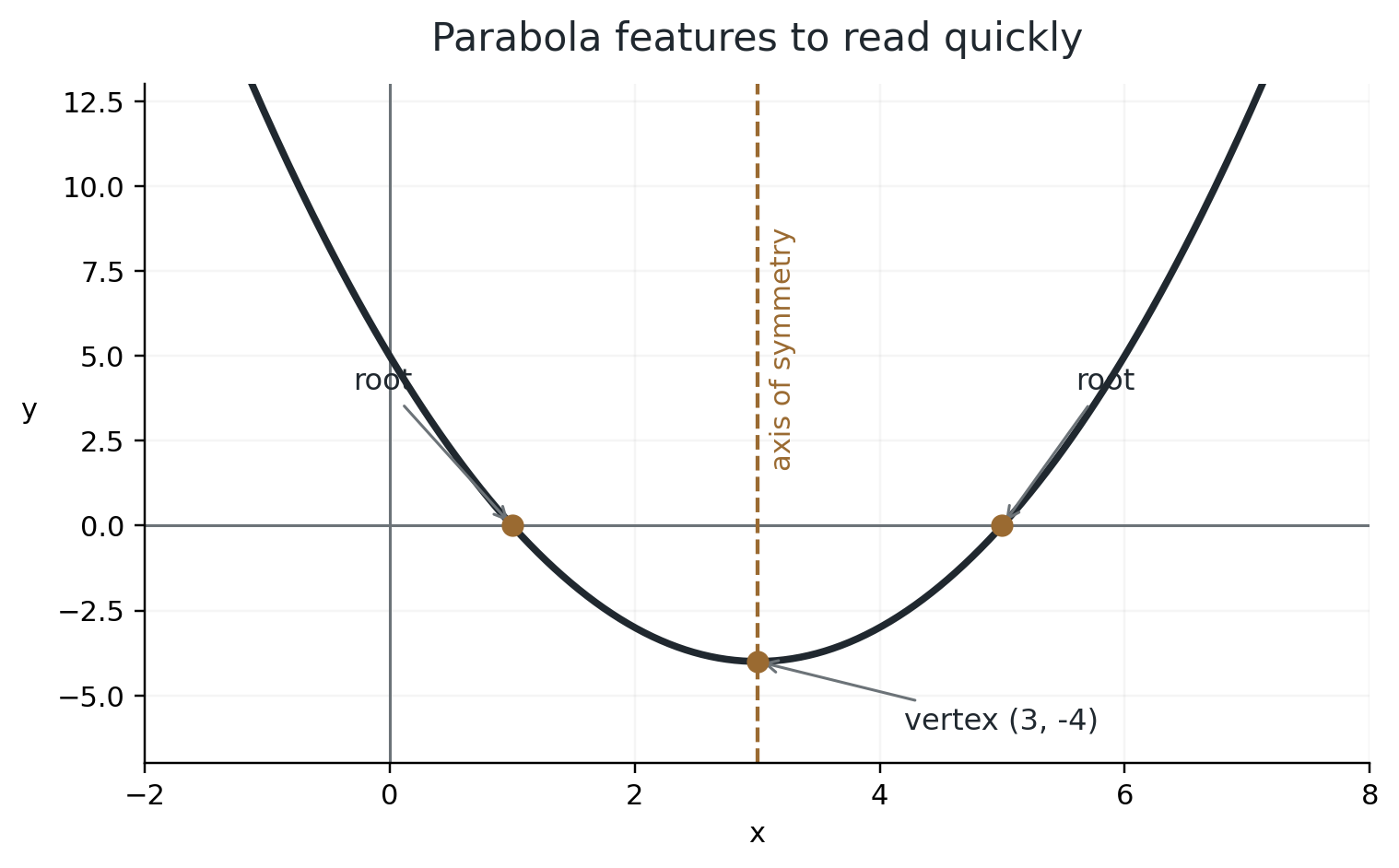
Concept diagram: roots, vertex, and axis of symmetry.
Completing the square
Completing the square is useful when converting standard form to vertex form or when a quadratic does not factor conveniently.
Linear + quadratic systems
- Equate the two expressions for or substitute one into the other.
- Move all terms to one side.
- Solve the resulting quadratic.
- The number of real solutions equals the number of intersection points: 0, 1, or 2.
Absolute value
- If , then .
- If , there is one solution.
- If , there is no real solution.
For inequalities:
when .
Rational and radical equations
- For rational equations, exclude values that make a denominator zero.
- For radical equations, isolate the radical before raising both sides to a power.
- Check candidates in the original equation after squaring or clearing denominators.
EXTRANEOUS SOLUTION
A candidate produced during algebraic manipulation that does not satisfy the original equation.
Exponential Models, Polynomials & Function Structure
Linear growth
- is the initial value when .
- is the constant additive change per unit of .
- means increasing; means decreasing.
Exponential growth and decay
- is the initial value when .
- is the growth or decay factor for every units of .
- means growth.
- means decay.
- Growth by every units: .
- Decay by every units: .
- Keep the units of and consistent.
Repeated percent change:
A useful distinction:
- constant difference between outputs suggests linear behavior,
- constant ratio between outputs suggests exponential behavior.
Polynomials and remainders
Polynomial division structure:
Remainder theorem:
Factor theorem:
Equivalent expressions
Factor, expand, combine like terms, or rewrite exponents strategically. SAT questions often reward recognizing structure instead of performing long arithmetic.
Function transformations
| Transformation | New function |
|---|---|
| Up units | |
| Down units | |
| Left units | |
| Right units |
Horizontal changes act in the opposite direction of the sign inside the input.
For compositions, means evaluate first, then use that result as the input of .
DESMOS DECISION
Desmos is excellent for intersections, roots, tables, regression, and verification. It is not automatically faster than recognizing a simple slope, vertex, factor, or scaled expression by hand.
Lines, Angles, Triangles & Coordinate Geometry
Angle relationships
- Vertical angles are equal.
- A linear pair sums to .
- Angles around a point sum to .
- For parallel lines cut by a transversal:
- corresponding angles are equal,
- alternate interior angles are equal,
- same-side interior angles are supplementary.
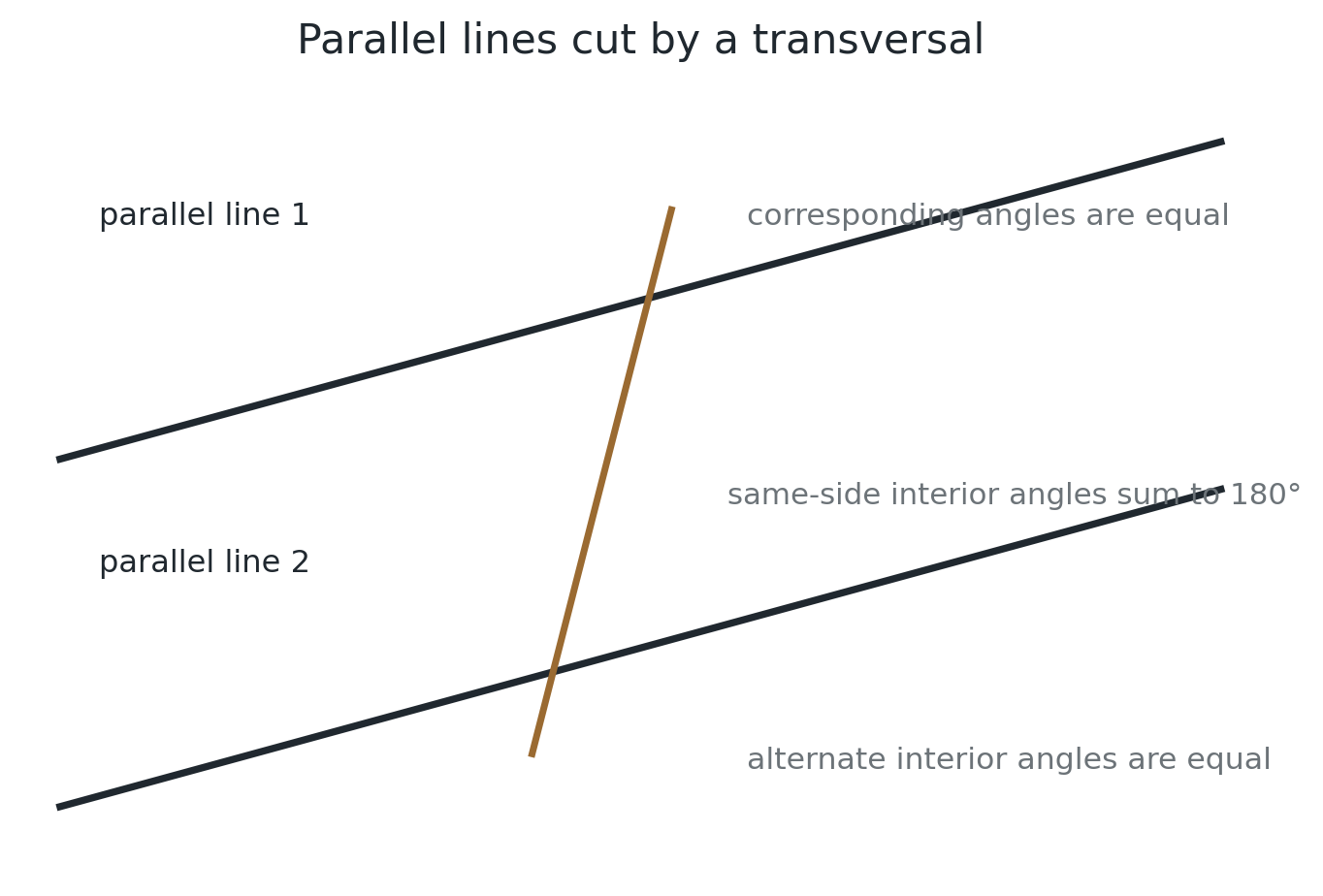
Concept diagram: parallel lines and a transversal.
Core triangle facts
- Interior angles of a triangle sum to . PROVIDED ON SAT
- Isosceles triangle: equal sides have equal opposite angles.
- Equilateral triangle: all sides are equal and all angles are .
- Similar triangles have equal corresponding angles and proportional corresponding sides.
- Congruent triangles have equal corresponding sides and angles.
Triangle area:
PROVIDED ON SAT
Pythagorean theorem:
PROVIDED ON SAT
Useful Pythagorean triples include 3-4-5, 5-12-13, 8-15-17, and 7-24-25. Multiples also work.
The 30-60-90 and 45-45-90 side relationships are PROVIDED ON SAT.
Similarity and scale
For similar figures, corresponding lengths share one scale factor .
Areas scale by and volumes by .
Congruence and similarity tests
- SSS: Side-Side-Side congruence
- SAS: Side-Angle-Side congruence
- ASA: Angle-Side-Angle congruence
- AAS: Angle-Angle-Side congruence
- HL: Hypotenuse-Leg congruence for right triangles
- AA: two equal angle pairs are enough to prove triangle similarity
Sufficiency traps: AAA proves similarity, not congruence. SSA is not generally enough information to prove triangle congruence.
Coordinate geometry basics
Midpoint of and :
Distance between two points:
This is the Pythagorean theorem written in coordinate form.
Circles
Equation and geometry
KNOW: center and radius .
To rewrite a general circle equation into standard form, complete the square separately for the -terms and -terms.
Circle area:
PROVIDED ON SAT
Circumference:
PROVIDED ON SAT
Arcs and sectors
In degrees:
A full circle is
When θ is measured in radians:
for arc length, and for sector area.
Angles and tangents
- A radius drawn to a point of tangency is perpendicular to the tangent line.
- The measure of a minor arc equals the measure of its central angle.
- A central angle is twice an inscribed angle when both intercept the same arc.
- An angle inscribed in a semicircle is .
Fast circle-equation reading
If the equation is already in standard form, do not expand it. Read the center and radius directly.
For
the center is
the radius is
SAT HABIT
Check whether the question asks for radius or diameter. Many avoidable errors happen after the circle has already been solved correctly.
Trigonometry & the Unit Circle
Right-triangle trigonometry
Complementary-angle relationships:
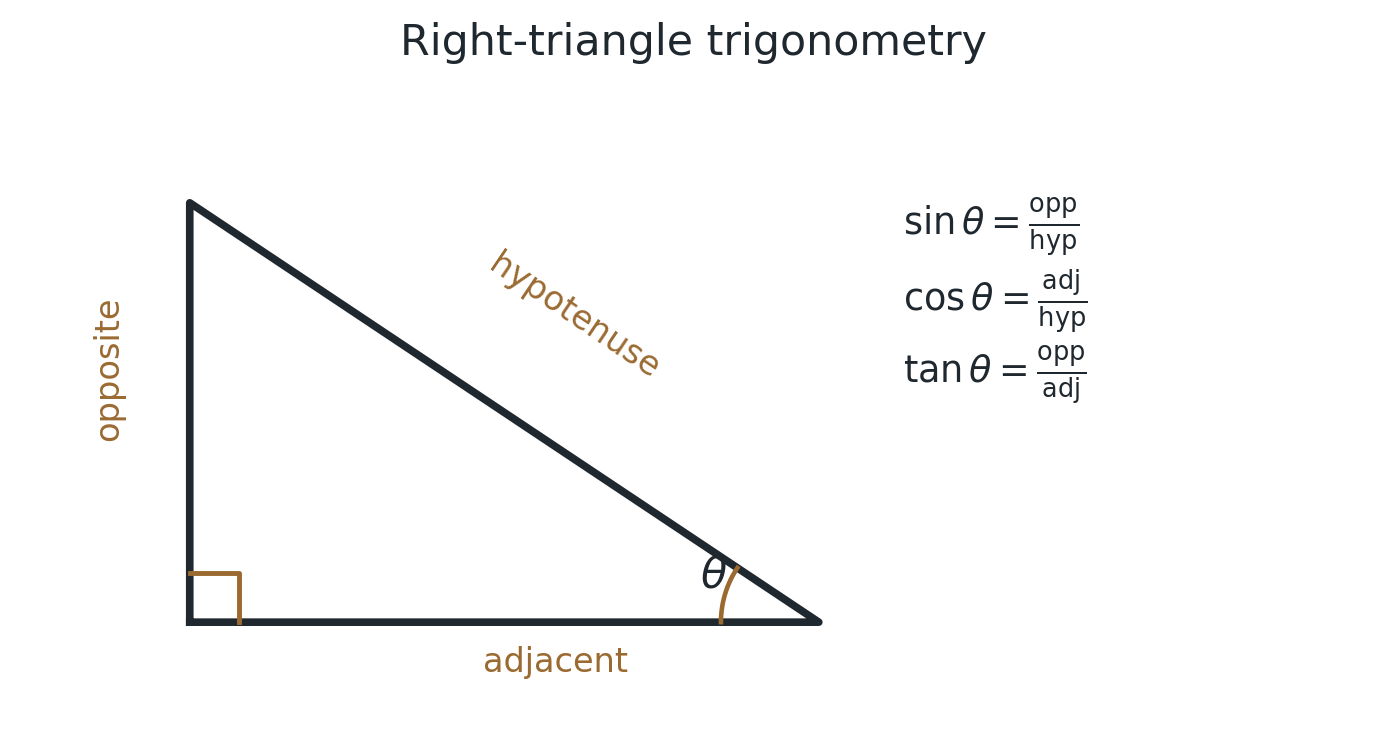
Concept diagram: opposite, adjacent, and hypotenuse relative to angle theta.
Unit circle
At angle , the point on the unit circle is
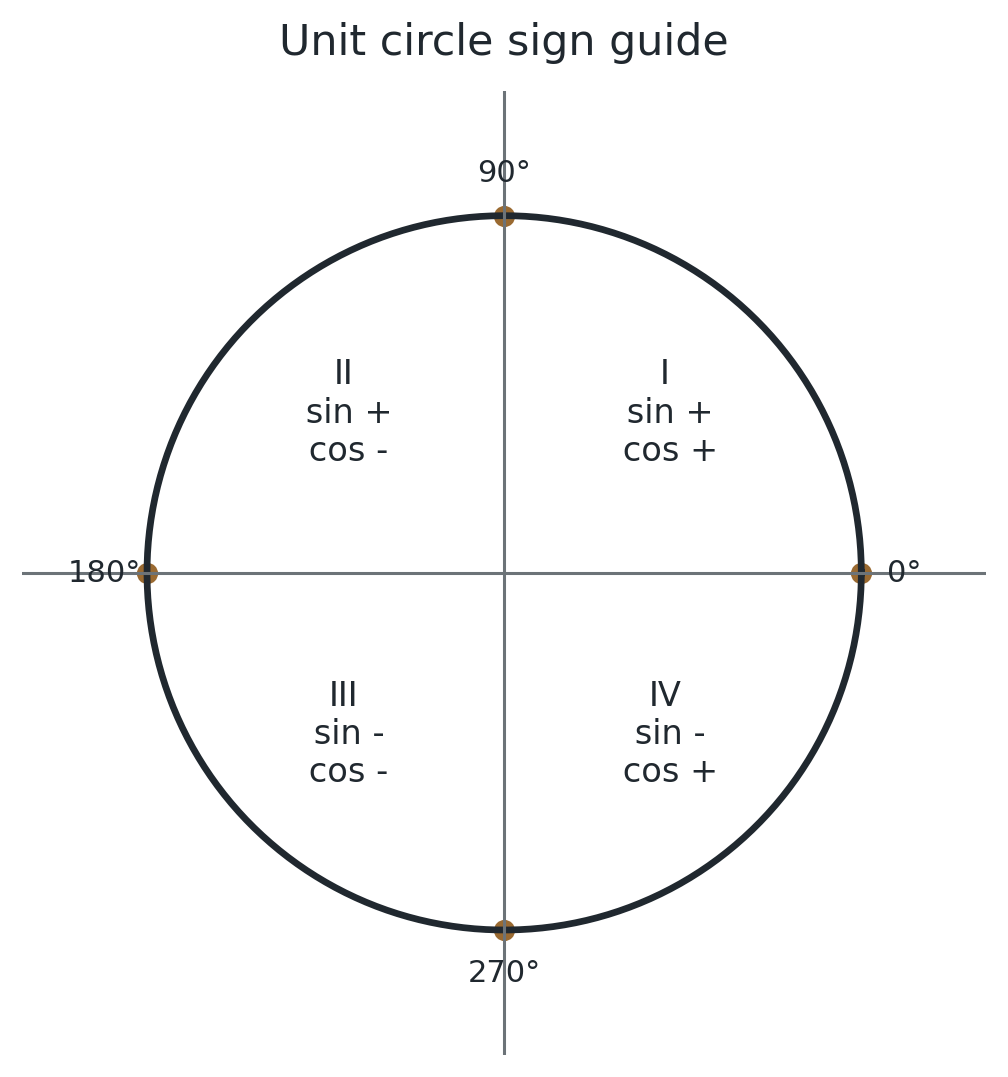
Concept diagram: signs of sine and cosine by quadrant.
The reference sheet gives the two special-right-triangle relationships, so use them to reconstruct exact sine and cosine values rather than memorizing a large table blindly.
Area, Surface Area, Volume & Scale
Formulas provided on the SAT reference sheet
| Shape | Formula | Status |
|---|---|---|
| Circle | , | PROVIDED |
| Rectangle | PROVIDED | |
| Triangle | PROVIDED | |
| Right triangle | PROVIDED | |
| Rectangular prism | PROVIDED | |
| Cylinder | PROVIDED | |
| Sphere | PROVIDED | |
| Cone | PROVIDED | |
| Rectangular pyramid | PROVIDED |
The reference sheet also provides the 30-60-90 and 45-45-90 triangle relationships, radians, and the fact that triangle angles sum to .
Useful formulas to know
Cube surface area:
Rectangular prism surface area:
Cylinder surface area:
Sphere surface area:
Any prism or cylinder:
where is the area of the base.
Any pyramid or cone:
Equilateral triangle area:
Area using two sides and the included angle:
Polygons
Sum of interior angles of an -sided polygon:
Each interior angle of a regular -gon:
Scale factor reminder
If every length is multiplied by :
UNIT TRAP
A linear conversion factor must be squared for area and cubed for volume. For example, , but .
Strategy, Desmos & the Last 50 Points
Before you calculate
- Check what the question actually asks for. If you solved for , make sure the requested quantity was not , , a radius instead of a diameter, or another related value.
- Look for structure before doing arithmetic. A scaled equation, equivalent expression, or relationship may give the answer without solving every variable.
- If answer choices contain variables, plugging in simple values can be useful when those values do not violate restrictions.
- If a point is labeled on a graph or given in the question, substitute it into the equation before doing anything more complicated.
- Translate word problems into equations, inequalities, proportions, or functions as early as possible.
- For diagrams, mark every known angle, side, parallel line, radius, or right angle.
- Before solving for or , ask whether the requested expression can be obtained directly.
- Check restrictions: denominators cannot be zero; even roots need nonnegative radicands in real-number problems.
- Check whether an answer is reasonable in context. A negative length or an impossible probability is a warning sign.
Desmos: a tool, not a reflex
Use Desmos when it genuinely saves time:
- intersections,
- roots and zeros,
- graph behavior,
- tables,
- regression,
- checking an answer.
Do not open Desmos automatically for a question that can be answered mentally or with one clean algebraic step.
A graphing window can hide relevant behavior. If you use a graph, make sure the window includes the region the problem cares about.
For systems, the intersection point can be useful, but first check whether coefficient relationships make the answer obvious.
The last 50 points
- Accuracy comes before speed. Speed built on unstable algebra only creates faster mistakes.
- If your mind goes blank on one question, move on and return. Spending several minutes protecting one question can cost easier questions later.
- At higher scores, points are often lost through interpretation, pacing, sign errors, unnecessary calculation, and answering the wrong quantity rather than through missing a major formula.
- When reviewing a mistake, identify the reason: concept, algebra, arithmetic, interpretation, calculator choice, or timing. Fix the reason, not only the answer.
- Practice slightly harder than the real test so ordinary SAT questions feel more manageable under time pressure.
MY RULE
I do not correct the answer first. I correct the reason. Practice should make the real test feel easier, not merely familiar.
Official SAT References
This handbook’s test structure, content-domain coverage, response-entry rules, calculator policy, and reference-sheet statements were checked against current College Board materials in September 2026.
- College Board: SAT Math Specifications
- College Board: SAT Math Overview
- College Board: SAT Suite Calculator Policy
- College Board: Assessment Framework for the Digital SAT Suite
College Board and SAT are trademarks of College Board. This handbook is independently prepared and is not affiliated with or endorsed by College Board.